[Case study]2026

Go deep on how AI answers about you

Role
Product, design & engineering
Year
2026
Type
Side project · Web app + Chrome extension
Status
In development
deep — live checkdelta.com
Prompt 03 / 12

“What's the best airline for business travel in the US?”

  • ChatGPT1. Delta2. United3. AmericanDelta · #1
  • Claude1. United2. Delta3. AlaskaDelta · #2
  • Gemini1. Delta2. United3. JetBlueDelta · #1
  • Perplexity1. United2. Delta3. AmericanDelta · #2
  • AI Overviews1. United2. American3. Southwestnot mentioned

( Overview )

Buyers now ask ChatGPT, Claude, Gemini, Perplexity and Google's AI Overviews which product to choose. Deep asks those engines your buyers' questions, live, in your own browser, and shows whether your brand is in the answer, where it ranks, what the engines say about it and what to publish next.

[01]/ The problem

When someone asks an AI engine for the best airline for business travel, there is no page of ten blue links. There is one answer, and either your brand is in it or it isn't.

Most visibility tools estimate that answer through APIs or sample data. Deep takes the opposite approach: it reports only what the real engines said, in the same interface a buyer sees, and keeps every answer as evidence.

[02]/ The evidence

Most AI visibility tools measure through the model APIs. Independent comparisons keep finding that API answers and what a buyer sees in the app are very different, which is why Deep reads the real interface.

11%

Brand overlap between API and chatgpt.com answers across 834 prompts[1]

13%

Answers where API and app agreed on the top brand[1]

15.2 vs 4.4

Sources cited per answer, app vs API[1]

59% → 0%

Same tool, visible in API answers and absent from the app[2]

( References )

  1. [1]

    Brandlight — UI vs API (June 2026) ↗

    834 matched prompts. Brand overlap of 11%; the top brand matched in 13% of answers; the app cited 15.2 sources per answer vs 4.4 via API.

  2. [2]

    Windsor.ai — AI visibility tracking accuracy (Sep 2026) ↗

    With identical prompts, one tool appeared in 59% of API answers and 0% of app answers. Notes that most AI visibility tools measure via API.

  3. [3]

    Genezio — Zero query overlaps: GPT-5.2 (API) vs ChatGPT.com ↗

    3,645 conversations about UK banks: API and web ran entirely different searches. Recommends measuring on the web and using the API only as a complement.

  4. [4]

    Surfer SEO — LLM scraped AI answers vs API results (Dec 2025) ↗

    API answers were shorter, and in 8% of cases no brand was detected at all.

  5. [5]

    Mentions API — API vs UI gap ↗

    Reports a different brand order between API and app in 64% of prompts. Self-published by a vendor, so weigh it lightly.

  6. [6]

    Search Engine Land — Repeated ChatGPT runs and brand visibility ↗

    On how brand visibility shifts across repeated runs of the same prompt.

Most of these studies were published by companies that sell tools in this space. Read them as a strong, consistent signal rather than a final word.

[03]/ How it works
  1. 1

    Set up

    Enter your domain, the competitors you care about and the questions your buyers actually ask.

  2. 2

    Ask

    The Deep Live Check extension types each question into ChatGPT, Claude, Gemini, Perplexity and Google, a few seconds apart.

  3. 3

    Read

    Every answer is saved in full: which brands appear, where yours ranks and which websites the engines cite.

  4. 4

    Track

    Run the same check next week and see whether your share of answers is going up or down.

[04]/ Inside the product
[01] / Report

Visibility at a glance

Each check becomes a report: how often your brand shows up, its average position among the brands you track, who wins the most answers and how many sources the engines lean on.

  • Live visibility and average position
  • Mention rate per engine
  • Share of answers for every tracked brand
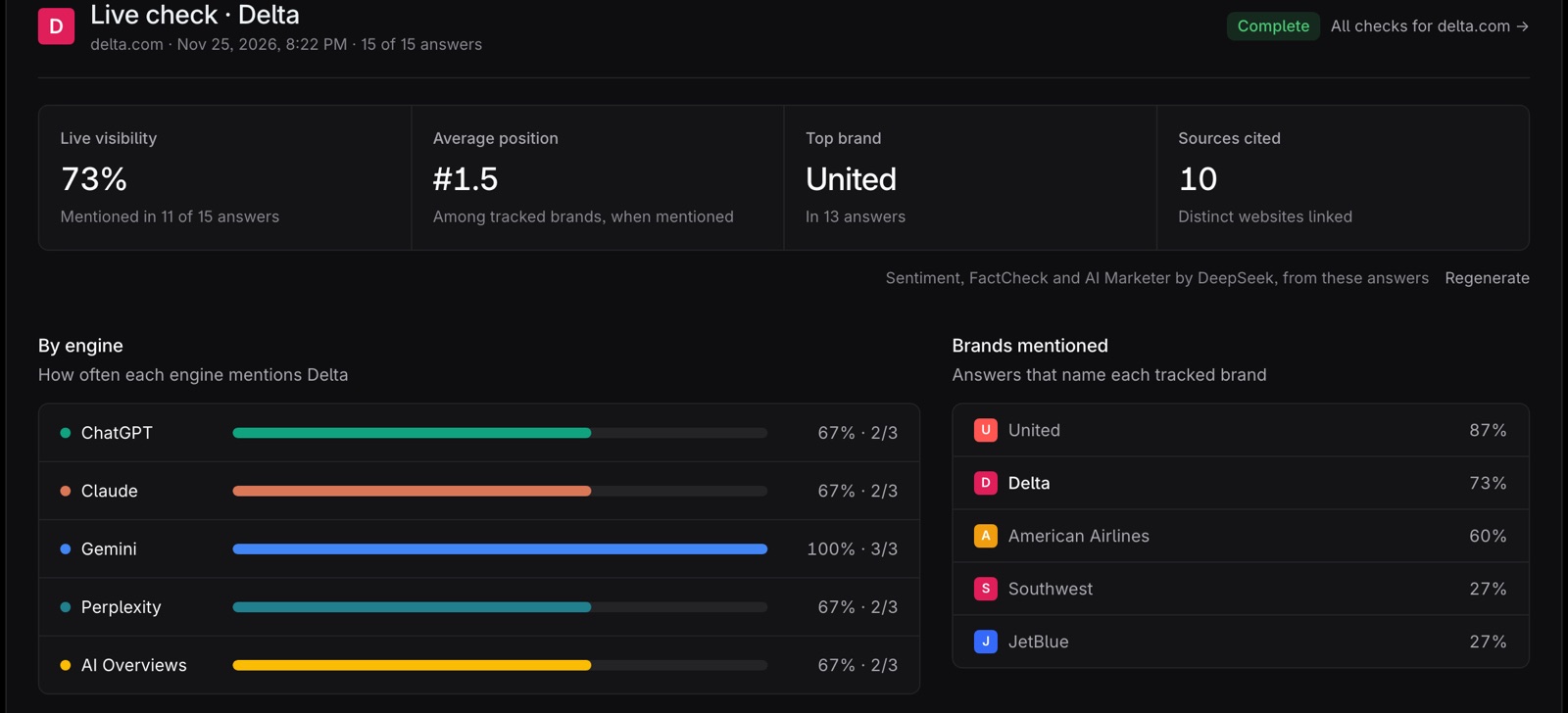
Report KPIs for Delta: 73% visibility, average position 1.5, top brand United, 10 sources, with bars per engine and brands mentioned
[02] / Extension

Runs in your own browser

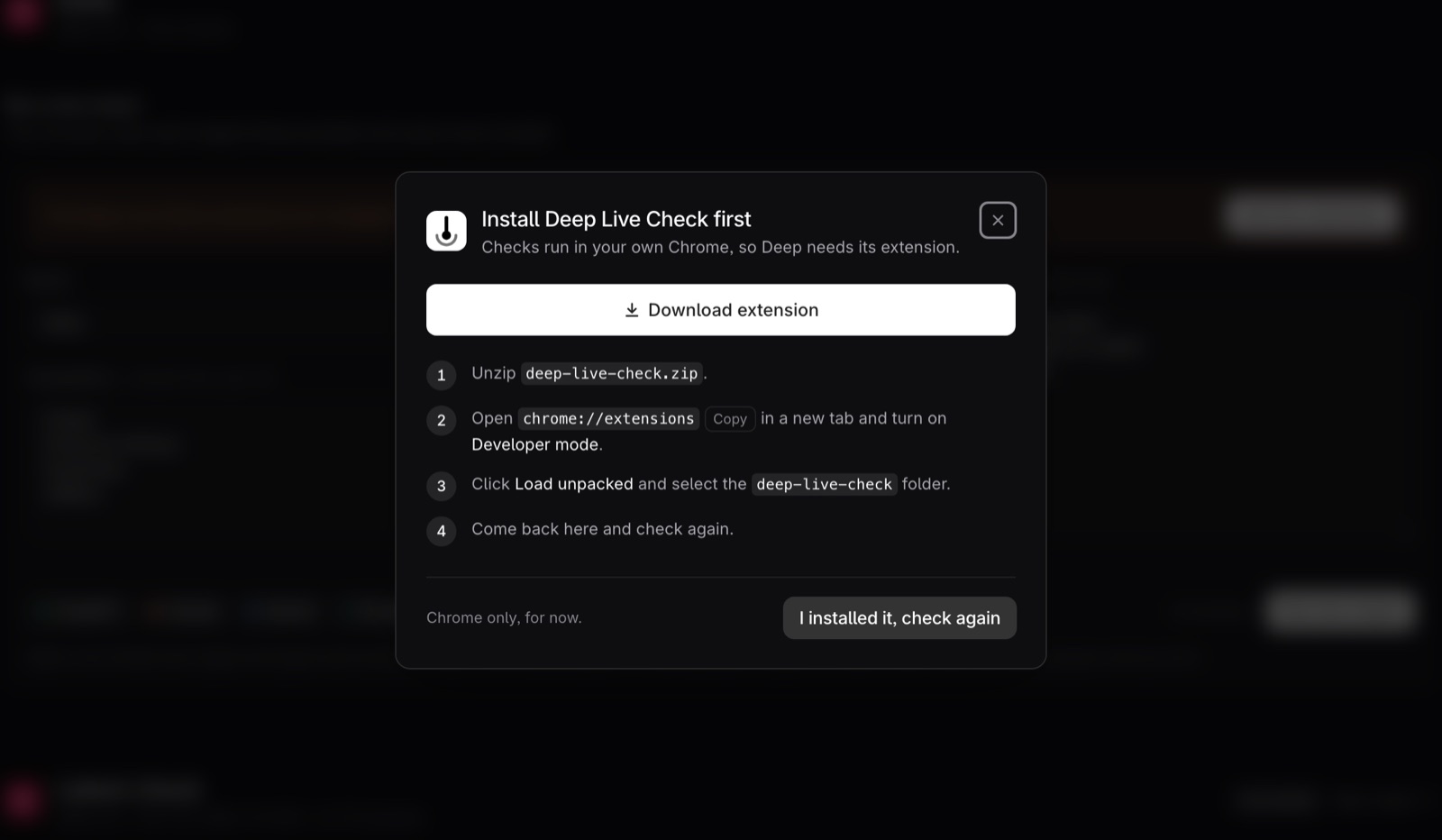
Checks run through a Chrome extension instead of a server farm. It opens one visible window per engine, types each prompt with human pacing and reads the full answer once it finishes streaming.

  • One-click install flow from the app
  • Pauses on CAPTCHAs or sign-in, never bypasses them
  • ChatGPT runs in temporary chats
Modal explaining how to install the Deep Live Check Chrome extension in four steps
[03] / Sentiment

Not just if, but how

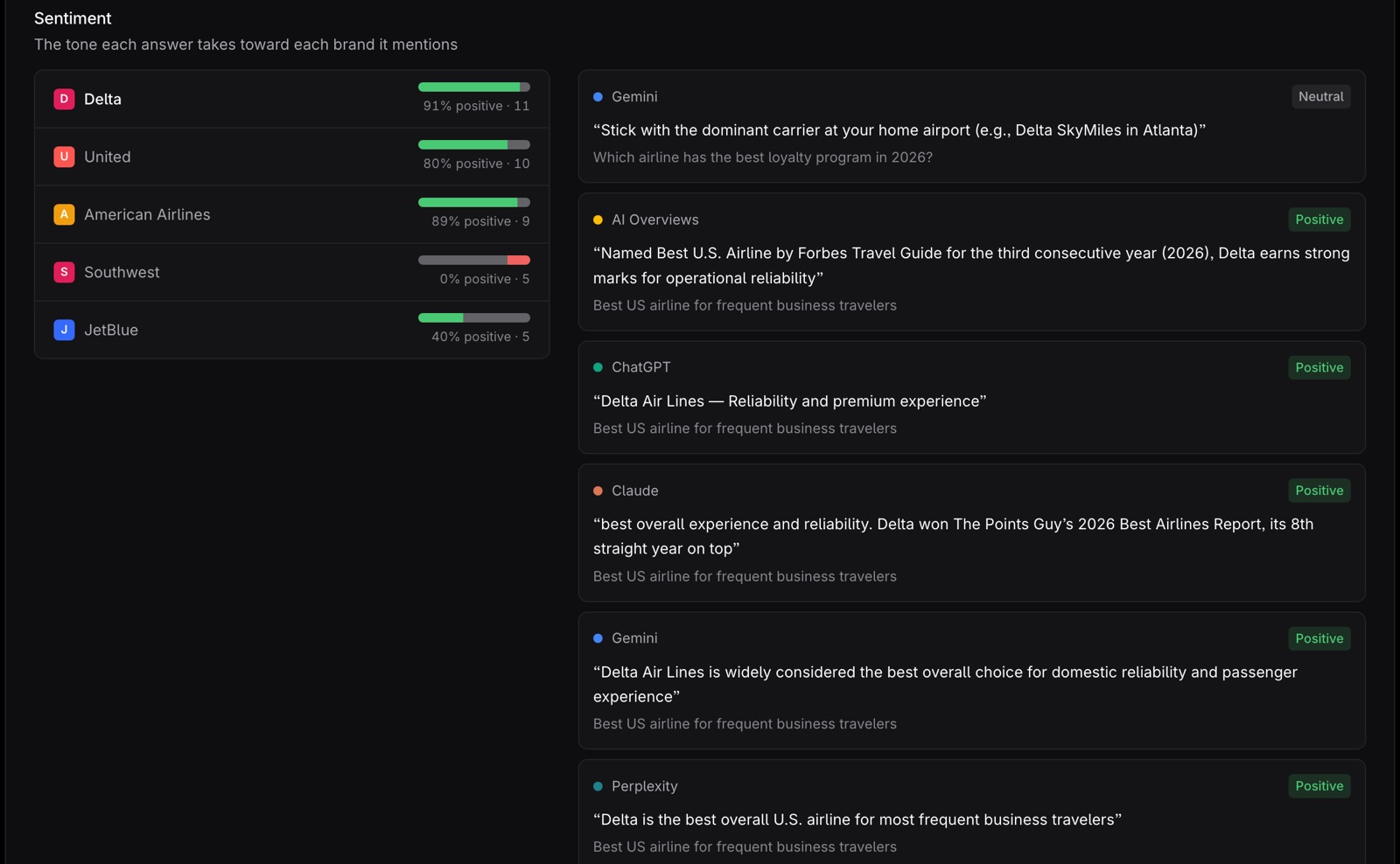
Being mentioned isn't enough. Deep scores the tone each answer takes toward every brand and keeps the exact quote behind each score, so the number is always backed by what the engine wrote.

Sentiment per brand with positive percentages and quotes from each engine
[04] / FactCheck

Where the engines disagree

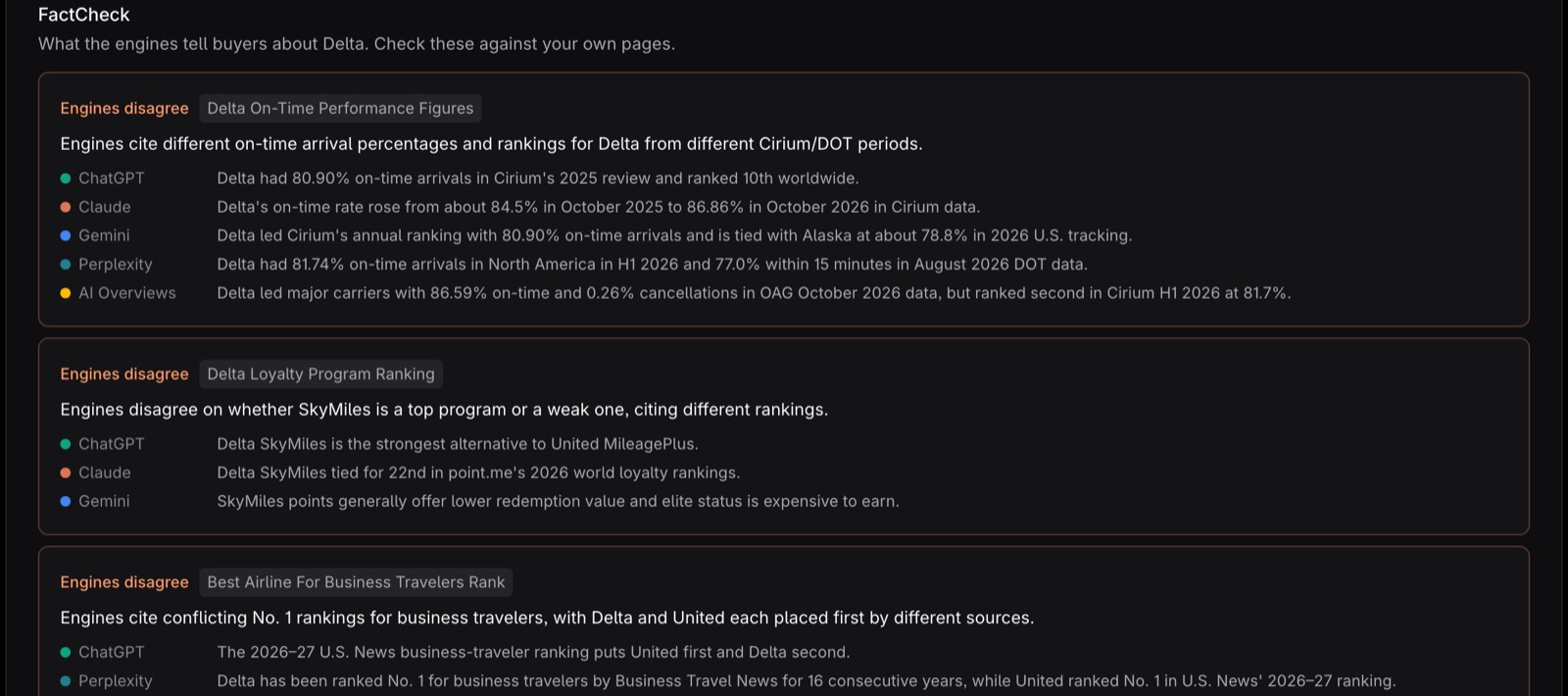
FactCheck groups the claims each engine makes about your brand and flags the topics where they contradict each other, such as different on-time figures or rankings, so you know which facts to fix on your own pages.

FactCheck cards showing engines disagreeing on Delta's on-time performance and loyalty program ranking
[05] / AI Marketer

What to publish next

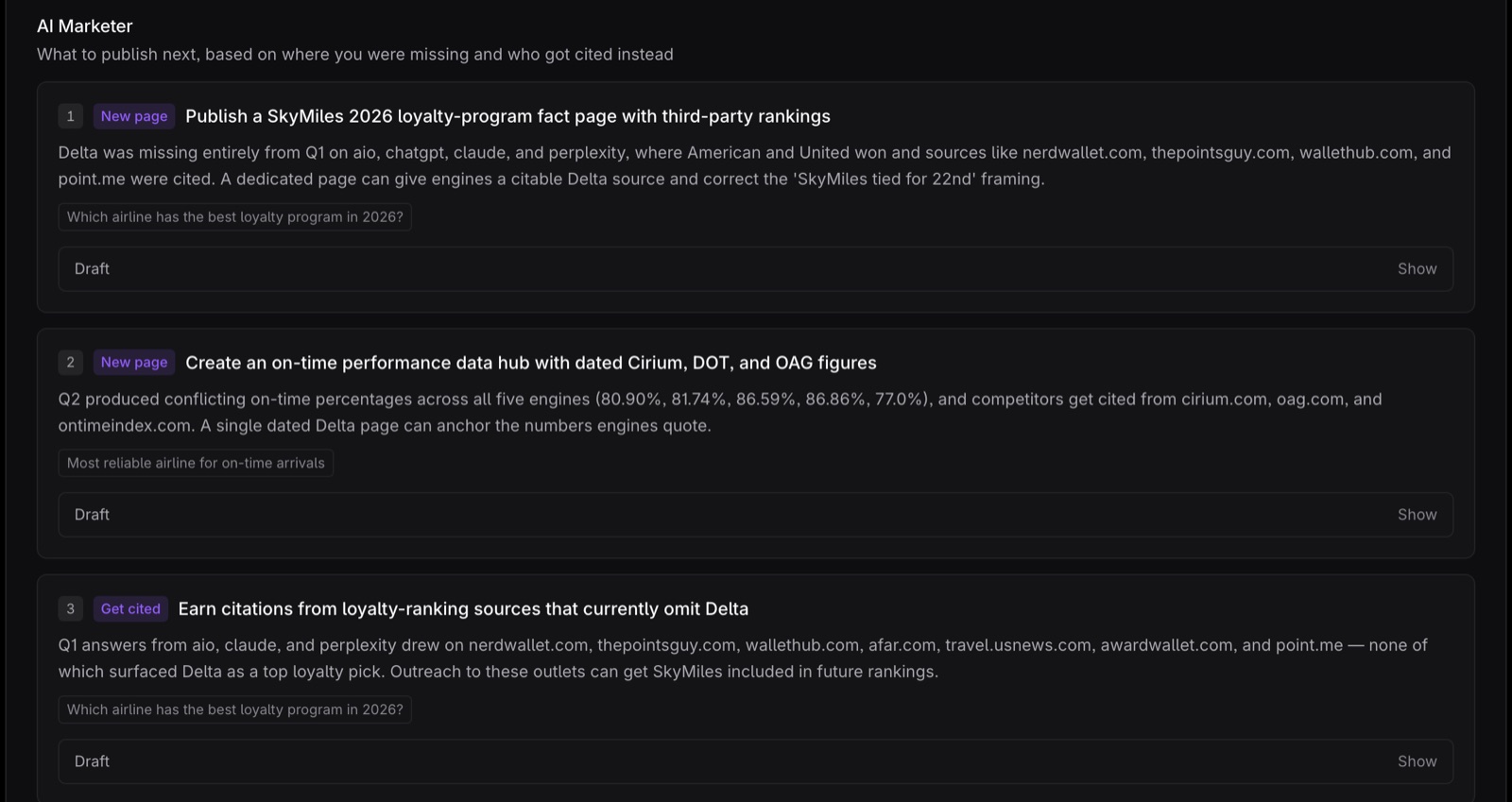
From the gaps in the answers and the sites cited instead of you, AI Marketer proposes concrete actions, from new pages to outreach, each tied to the prompt that triggered it and with a draft ready to edit.

AI Marketer actions: publish a loyalty-program fact page, create an on-time data hub, earn citations from ranking sources
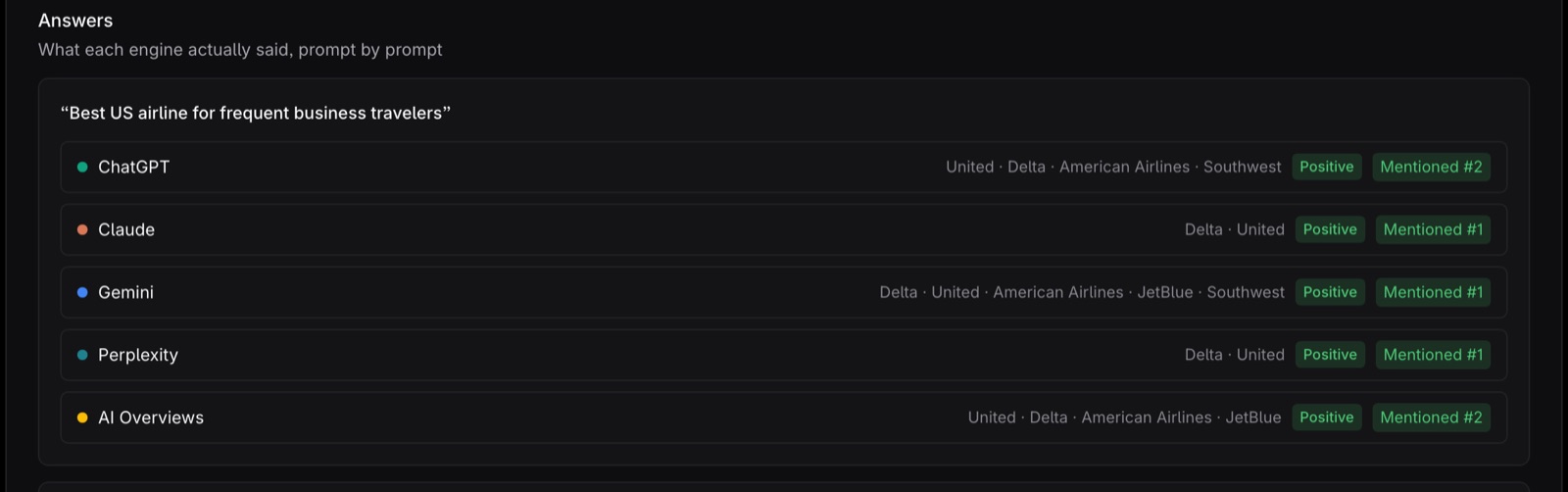
[06] / Answers

Every answer, as evidence

Nothing is summarized away. For each prompt you see what every engine said, which brands it named, in what order and with what tone.

Answers for one prompt across five engines with brands named, sentiment and mention position
5
Answer engines
100%
Real answers, no estimates
0
DB keys shipped in the extension
[05]/ Engineering

[01]

A thin, safe extension

The Manifest V3 extension only drives the engine tabs and posts answers to the app's API. It never talks to the database, so no credentials ship with it, and runs can only be started from the local app.

[02]

Analysis grounded in answers

Sentiment, FactCheck and AI Marketer are computed with an LLM in JSON mode from the saved answers. Nothing is generated without a real answer behind it, and every insight links back to its prompt.

[03]

Built to be re-run

Runs and answers live in Postgres on Neon, keyed by run, engine and prompt. Analysis is claimed per answer so it can resume, retry or regenerate without duplicating work.

[04]

Respectful automation

Visible windows, randomized pauses between prompts and a hard stop on CAPTCHAs or sign-in walls. The person stays in control of every run.

Next.js 16✳React 19✳TypeScript✳Tailwind CSS v4✳Framer Motion✳Neon Postgres✳Chrome Extension MV3✳DeepSeek API✳